



How to Integrate AI with LMS (Without Waiting for the Vendor)

If you’re searching for how to put AI in your LMS because it seems a list of steps will solve the problem you are dealing with, we’ve got some bad news. It’s a bit harder than that.
LearnUpon launched Create+ in March 2026. Docebo announced a full agent platform in April 2026. Moodle has carried an AI subsystem in core since 4.5.
They all work, but you might still need something more, as the ready solutions don’t always fit your needs fully, right?
That’s what happens when a vendor with thousands of customers decides what to build next. Obviously, they’ll build the features all customers can use. But features like CPD renewal rules, payroll field mapping, or a two-level franchise hierarchy can only be configured for one customer. That’s why they stay off the roadmap.
So you shouldn’t be asking yourself how to integrate AI with my LMS. The question you’re looking for is what’s blocking me from having the right AI features.
We are Academy Smart, and since 2009, we’ve built dozens of LMS, including those with AI features. Here, we’ll share how to tell which feature you really need, and how to choose between waiting for the feature, bridging a layer, or building something custom.
TL;DR
• Every major LMS has shipped the same 4 AI features: course generation, a chatbot trained on your content, quiz generation, and agents. None of them handle CPD rules, payroll joins, or per-client logic.
• Vendors build what all their customers can use. We call it The SaaS Roadmap Conflict.
• 42% of vendors report fully integrated AI against 7.5% of buyers. Vendors over-invest in content generation by 22 points and under-invest in personalization by 21.
• AI can’t be treated as one integration. It’s a decision at 5 layers: Architecture, Standards, Data, Integrations, Operations.
• Wait for generic features, bridge to the system that holds your data, and build only what encodes your regulator or business model.
Every AI-powered LMS has the same 4 features
Look across the market, and you’ll see the same 4 AI features everywhere:
Course generation from documents.
LearnUpon’s Create+ turns PDFs and videos into structured courses. Docebo has a Content Creator. Moodle generates text and images through whichever provider you connect.

A learner chatbot grounded in your own content.
Thinkific’s Thinker answers from your material. Litmos uses retrieval with course citations. LearnUpon has Lia. Docebo has an AI Tutor. Moodle has a Course Assistant.

Assessment generation.
LearnUpon builds questions from your training content. Docebo has a quiz-maker agent. LearnWorlds converts existing material into exams and certifications.

Agents and MCP servers.
Docebo’s AgentHub or LearnUpon’s MCP Server, which connects ChatGPT, Claude, or Gemini to your learning data.

6 vendors covering the same 4 features isn’t a coincidence. The eLearning Industry surveyed 400 L&D buyers and 100 learning technology vendors. They discovered that among vendors, 42% report fully integrated AI. Among buyers, only 7.5% adopted AI, and 45% are still at the planning stage. One side of the market has shipped, and the other hasn’t switched on.
As we can see, content generation and chatbots are available everywhere. But personalization, which buyers rank as the most valuable AI capability in learning, has a large gap.
That leads us to the next question: why doesn’t the market offer what customers want?
Why the AI feature you need is never there
It’s what we call The SaaS Roadmap Conflict. Features that scale across the whole customer base get built, but those that are specific to one buyer’s compliance rules, data structure, or integrations don’t. The reason is they raise support costs, break standardization, and can’t be sold twice.
As the report numbers show, there’s a visible gap between what the market offers and what clients really need.
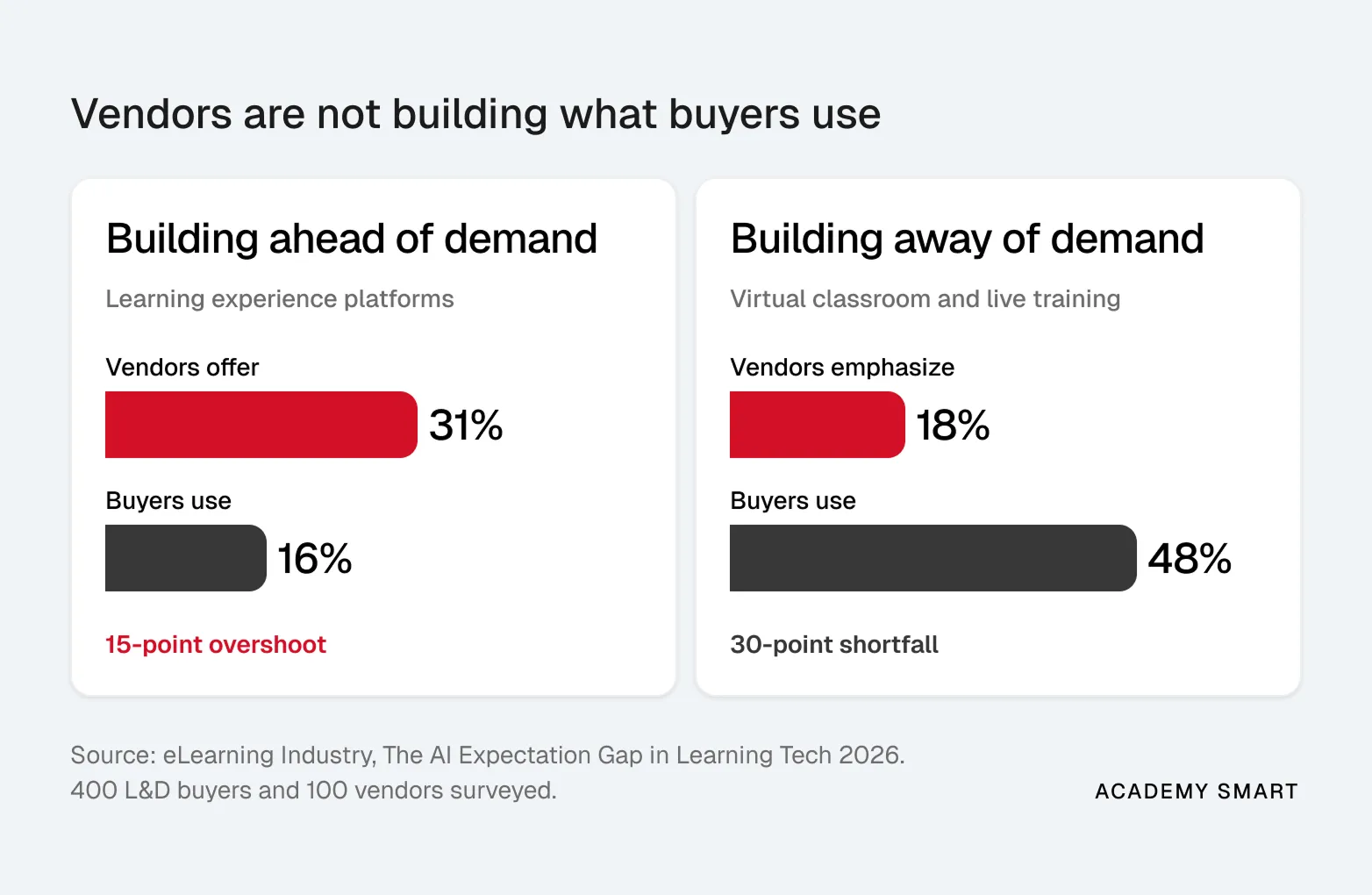
First of all, vendors build ahead of demand: 31% of vendors offer LXP capability while only 16% of buyers use it. They also build away from demand. 48% of buyers use virtual classroom and live training tools, and only 18% of vendors emphasize them.
The vendor also decides what leaves. Docebo announced the deprecation of its native Elucidat integration on June 15, 2026. As of that date, customers could no longer create or upload new training materials through it, and existing Elucidat content stays playable only until December 31, 2026. Teams that built workflows around the integration had to export their content out of Elucidat as SCORM or xAPI and re-upload it to Docebo on Docebo’s timeline.
Finally, AI is a pricing lever as well as a feature.
It’s typical behaviour for a subscription business serving thousands of accounts on one codebase, which is why it might be worth it to integrate AI with LMS on your own.
How to integrate AI on 5 architectural layers
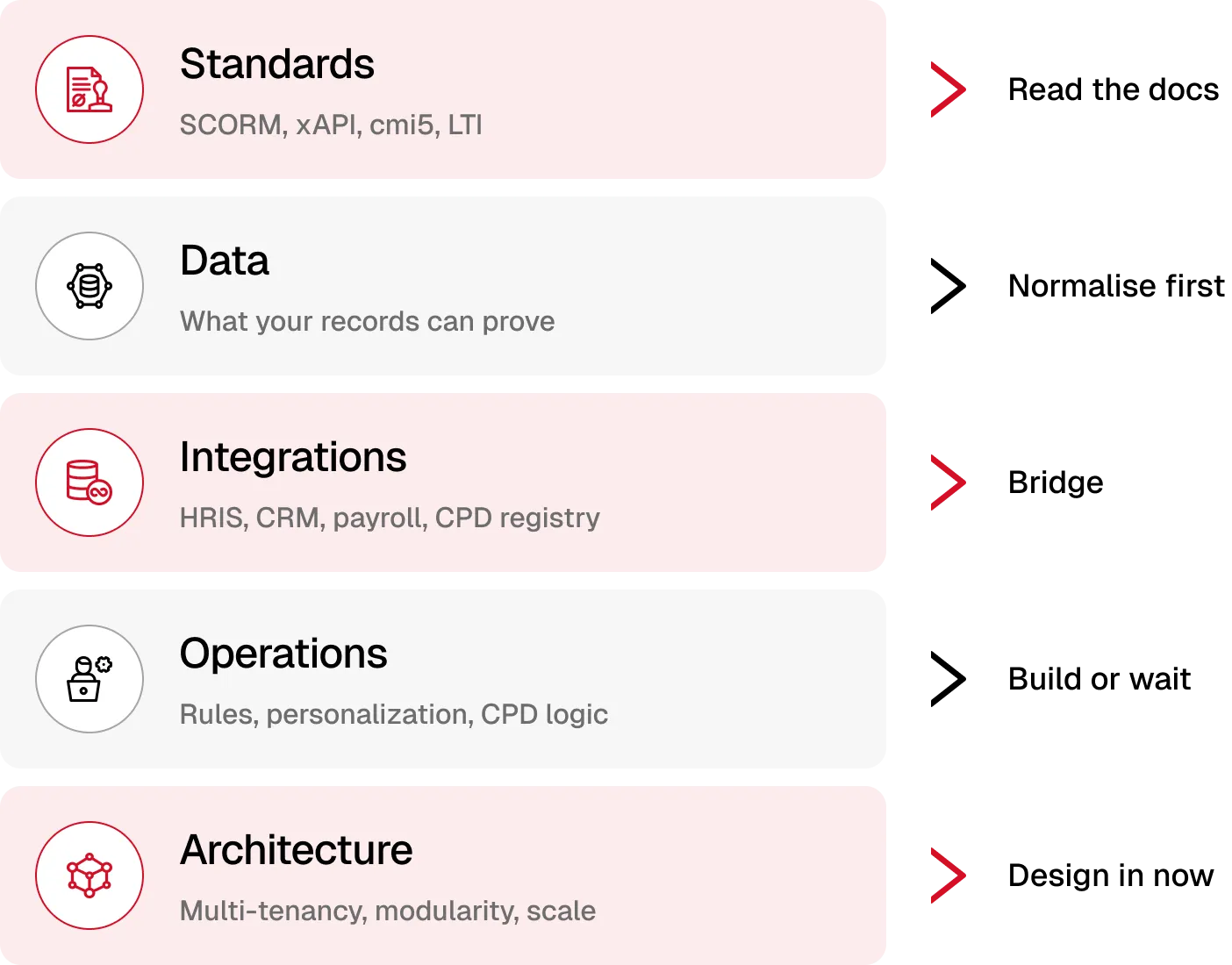
The 5-Layer LMS Implementation Stack breaks a learning platform into Architecture, Standards, Data, Integrations, and Operations. Each layer sets the limit for the one above it, which is why the answer to “how do I add AI” depends entirely on which one is stopping you.
Standards
Everyone skips this layer, but it decides everything above it.
Open your platform’s documentation and find one thing: whether it accepts xAPI or cmi5, or only SCORM.
That will explain a lot. SCORM sends back a completion and a score. A chatbot reading your course content does fine with that. A recommendation engine needs more, but SCORM doesn’t send the right signal.
This layer also holds your way in. LTI 1.3 lets you add a tool to an existing LMS without waiting for the vendor. It’s usually why a bridge beats a replacement.
Data
Pick one learner who’s been active for a year and export everything the system holds on them. Then see whether you can answer these questions:
- Which modules did they retry?
- How long were they inside each one?
- What training did they do that never touched the LMS?
- Which skills does this record prove?
Most exports fail all four. That’s your answer about personalization.
If you work under a regulator, the gap is wider still. Your LMS sees the courses it hosts, which is roughly a fifth of the development your people complete. The conferences, the external courses, the on-the-job learning and the self-reported hours live in spreadsheets.
We call that the CPD Visibility Gap, and we close it for our clients, for example, Ireland’s leading corporate law firm. 600+ solicitors now get compliance credit for external activity inside one system.
Buying an AI LMS before auditing your content ends in failure, because weak inputs spoil a good recommendation engine.
Start capturing the events you want now, even if nothing reads them yet just to have history.
Integrations
Write your question in one sentence, the way a line manager would ask it. Then work out which system holds each part of the answer.
Try this one: which field engineers are due for recertification before their next rotation? Certification is in the LMS. The rotation schedule is in workforce planning. Role and location are in the HRIS. Your LMS holds a third of it.
Then choose between a live join and a nightly sync, because that choice sets the price. If the answer changes hourly and triggers something, you need the join. If it changes weekly and feeds a report, one-way sync does it for far less. Most teams assume the first and need the second.
Read your integration list again with one distinction in mind: connectors that read documents, and connectors that read records. Docebo’s AgentHub reaches 20-plus sources including SharePoint, Confluence, Drive and Salesforce. Those answer questions about what your policy says, but they won’t tell you who’s out of compliance in your region.
None of this is easy, and the vendors agree. They name integration complexity as their second-biggest barrier to shipping AI, at 45%.
One thing we’d warn you about, having scoped this work many times over, is that the connection almost never breaks the estimate, but field mapping does. Specifically, the argument about what employee ID means in UKG versus AFAS versus your own database. For Teachers of Tomorrow, we had to join Azure AD, LearnUpon, and Stripe for 25,000+ learners without interrupting a single live course, and the mapping took longer than the rest.
Operations
Describe what you want automated as if you were briefing an administrator on their first morning. If you can state it as inputs, thresholds, and exceptions, it can be built. If you can’t, no model will guess it.
A CPD rule sounds like this. 20 hours a year, 4 of them in a named category. External activity counts if it’s certified. The year resets on a fixed date. Mid-year joiners get a smaller target.
Such a rule belongs to one profession, and that’s why it will never reach the top of a SaaS vendor roadmap.
Course summaries and quiz drafting are the opposite. They are generic by design, already shipped everywhere, and a waste of your money to build.
To give you an example of how this works. For an emotional intelligence platform, we built a separate portal with two coaches on the OpenAI API, one for EQ and one for psychological safety. Each reads a user’s report and builds a plan from a library organised by competency.

It took us 4 months to first release, and now the platform has more than 38,000 users.
Architecture
This layer decides how expensive the other three layers will be, and it’s the only one you can’t fix later.
Look at what the vendors are going through right now. Every platform named in this article is fitting AI onto something designed before anyone had heard of a large language model.
The report shows it: 68% of vendors have added AI features and 59% have reorganised their roadmap around AI, yet most still describe their own AI as early rollout rather than finished. That’s why releases are slow, and features feel generic.
If you’re building a platform or replacing one, you can skip that problem. Three decisions cost you almost nothing at the design stage:

Record what learners do from day one, even if nothing reads it yet. You can add a recommendation engine in two years.
You can’t go back and recreate two years of missing history.
Keep your rules separate from the core system. CPD requirements, org hierarchy, who can see what. When these live in their own modules, changing one rule means testing one module. When they’re baked into the core, changing one rule means retesting the whole platform.
Make sure you can get your data out through an API you control. Otherwise every future AI tool has to be one your vendor already integrates with.
Now you know which layer is stopping you. Match it against the answer to see whether you should wait, bridge to the system that holds it, or build.
Wait, bridge, or build?
Match the missing capability to its layer to see the recommended strategy:
If you want more details, check out our guide on whether you should build or buy LMS software.
And if you’re curious about prices for a custom LMS, we at Academy Smart share it openly. We offer a pre-built LMS foundation at $17K or $800 per month that counts in total cost, so you invest instead of renting someone else’s platform. For this price, you get:
- Production-ready LMS deployed on your infrastructure
- Multi-tenant architecture, white-label branding
- SCORM, xAPI, AICC support out of the box
- Learning path builder, role-based access, bulk CSV onboarding
- Pay in full or monthly
- Optional support retainer after launch
Full custom runs from $85K at a fixed price and delivers in about 6 months.
Set that against a SaaS platform costing $23–35K a year and the custom build pays for itself inside two years, after which the cost stops rising every time you add a learner.

The cost of waiting is harder to put on an invoice, which is how it usually wins the argument by default. It should not. Waiting costs you a roadmap you don’t control.
Before you write another RFP
Run these five checks in order. They form the AI-Readiness Stack for any LMS:
- Is your learning data clean and usable?
- Do you actually own and control your analytics?
- Are your workflows extensible — so AI can trigger real actions, not just surface insights?
- Can the system connect to the other platforms that hold the answers (HRIS, CRM, product data, etc.)?
- Is the architecture modular enough that you can change the AI logic later without breaking everything?
If three or more of these fail, the missing AI feature was never the real problem. No vendor roadmap or new release will fix that.