




Best LMS Development Companies for Custom Builds to Consider in 2026
At some point, your trustworthy learning platform, which was supposed to simplify things, became its own problem.
The LMS can’t host video well, so you added a tool for that. No useful analytics, so you connected another one. Can’t track compliance, so you bought something for that.
Then you realize the LMS was never built for what you do now. And when that realization lands, most teams start searching for a development partner who can build something that fits. This article is for that moment.
We are Academy Smart, a custom LMS development company that has been building LMS for the last 15 years. After being on the market for that long, we decided to list the top companies worth talking to in 2026, organized by what they do, with their strengths and trade-offs.
One clarification up front: this list covers custom LMS development firms and implementation specialists, so these are companies with the best LMS developers that build or configure learning infrastructure. It is not a ranking of SaaS platforms like Docebo, Thinkific, or LearnWorlds because those belong in a separate list
TL;DR
There are 3 types of LMS development companies: custom builders, open-source specialists, and SaaS partners
Custom builds start from $55K–$115K+ and deliver in ~6 months; open-source carries $35–90K/year in ongoing costs; SaaS partners keep you on the vendor’s roadmap

LMS-only engineering partner for training providers and regulated orgs

Training infrastructure studio for fast-growing provider

Custom LMS and learning apps for healthcare and pharma.

The Open edX specialist for universities and large-scale public programs.

Makes Cornerstone OnDemand work at enterprise scale.

The call to make when your LMS needs to talk to Workday, SAP SuccessFactors, or Cornerstone.
3 types of LMS development companies
Before you contact anyone on this list, it’s worth being clear on which category of partner you’re looking for. There are three types of LMS development companies, each of which solves different problems:
Custom LMS development firms
They’ll build a platform you own, either from the ground up or from a pre-built foundation.

Open-source specialists
They implement and extend platforms like Moodle, IOMAD, or Open edX.

SaaS & extension partners
These are platforms like LearnUpon, Cornerstone, or Docebo.

- Custom LMS development
gives you full ownership with no ceiling on what you can build. The tradeoff is higher upfront investment (typically $55K–$115K+) and a build timeline that, with the right partner, runs around 6 months. - Open-sources
like Moodle and Open edX carry no licensing fee, but they carry everything else: plugin maintenance, security patches, and architecture debt. You will need developers to maintain it. That typically adds up to $35–90K per year in ongoing engineering, sometimes more. It’s the right call for specific contexts but not a cost-cutting move. - SaaS partners
configure and extend platforms you don’t own. This means lower upfront cost, faster go-live, and a ceiling that belongs to the vendor. Per-seat pricing follows you as you grow. This can be the right choice as the first step, but not a long-term strategy.
All three categories are in this list because the right answer depends on where your company is. With this context added, let’s continue with our handpicked list of LMS development companies.
Best LMS development companies: custom builds, open-source & SaaS
There are 6 companies we think you should know about across all three categories. We know our own work best, so we’ll start with custom LMS development.
3 best custom LMS development firms
Custom LMS development is the right category if you’ve hit the ceiling of what a SaaS platform will build for you, if per-seat pricing is compressing your margins, or if your current setup runs on workarounds. The companies below build platforms you own.
Academy Smart
Best for: Corporate training providers and regulated organizations that have outgrown SaaS and Moodle.
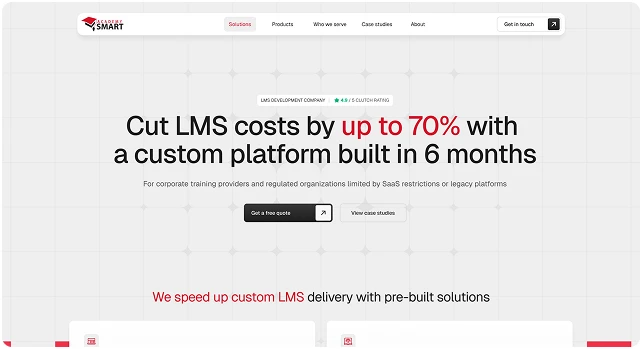
At Academy Smart, we do one thing, and it is LMS software development services. And without boasting (maybe just a little), we can say we are really good at it. Our team has been doing it for 15 years, so our developers arrive already knowing the industry specifics from SCORM edge cases to multi-tenant architectures and compliance rules.
We have a pre-built LMS foundation that covers roughly 80% of what any platform needs:
- User management
- Course delivery
- SCORM/xAPI
- Reporting
- Multi-tenancy
- Roles
The remaining 20% is what makes your business yours: integrations, compliance rules, monetization logic, and custom workflows. This approach allows us to deliver a custom LMS in 6 months, instead of the typical 12–18 months.
We are also a certified LearnUpon partner, so if you’re an existing LearnUpon customer, we can build capabilities the platform doesn’t have.
The caveat is that we are not the right fit if you want a subscription model. But here are some examples of what we can do for you.
What we’ve built: custom LMS, CPD compliance, AI-powered learning, and more
needed a multi-tenant LMS with enterprise-level security, so we built a custom platform from scratch. It launched in 5 months and cut their LMS costs by 68% compared to what a SaaS solution would have cost at that volume. They’re still our partner, five years and counting.

Ireland’s leading corporate law firm, had 600+ solicitors whose CPD activity was split between LearnUpon and spreadsheets. We built a CPD compliance layer on top of their existing LearnUpon setup with no disruption to their processes. External activities can now be logged directly, compliance rules are configurable, and every solicitor’s CPD status is visible in real time. Delivered in 2 months.
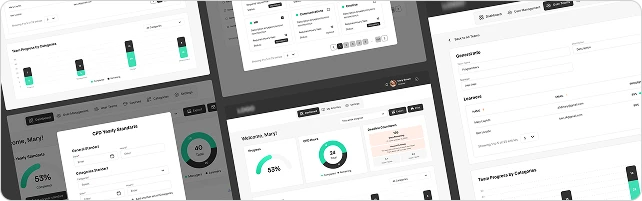
Ran emotional intelligence assessments that ended at the report. They decided to turn a one-time test into an ongoing learning journey. We built an AI-powered learning portal with OpenAI integration that translates assessment results into personalized content recommendations, tracking progress across 25 EQ competencies. The platform now serves 38,000+ users and growing.

Plume Studio
Best for: Fast-growing training providers that want to own their learning infrastructure without building from scratch.
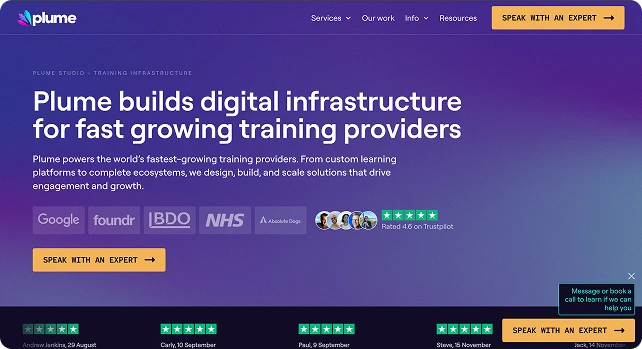
Plume positions itself as a training infrastructure studio, not just a development shop. The distinction shows in how they scope projects. They start with a strategy blueprint (planning, UX design, scoping) before writing a line of code.
Their delivery process covers the full stack: learning platform architecture, UX design, integrations, reporting dashboards, and migration. They also build marketing sites alongside LMS platforms, which matters for training businesses where the enrollment funnel and the learning platform are disconnected by default.
They promise a 12-week launch window for core builds with pre-built components. Their portfolio includes work for Google, Foundry, BDO, NHS, and Absolute Dogs. Sectors covered include B2B, B2C, healthcare, kids’ education, test prep, and memberships.
The Plume’s downside is that there is less evidence of them deploying LMS platforms for large-scale enterprises. Plume is a strong fit for training providers scaling their business, but not heavily regulated organizations.
Riseapps
Best for: Fast-growing training providers that want to own their learning infrastructure without building from scratch.
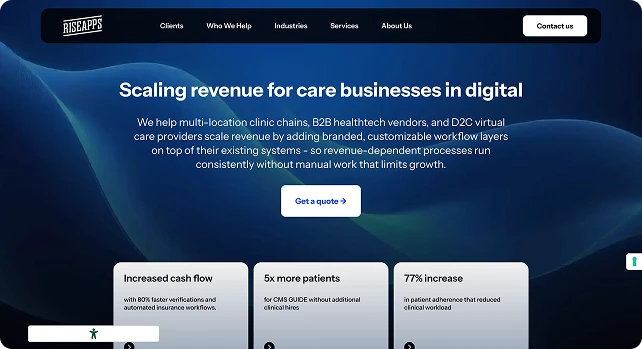
Riseapps is a software development firm with a meaningful track record in healthcare learning applications, which includes HIPAA-aware architecture, mobile-first design, and regulated-sector workflows.
They’re not an LMS-only shop, which cuts both ways: broader software experience gives them strong mobile and app development capability, but it also means you may be educating them on SCORM compliance rules rather than the reverse.
From what we can say, it is that they are deeper in healthcare app architecture than in LMS standards specifically. So if you decide to move on with Riseapps, it’s worth validating their SCORM/xAPI/LTI depth before committing.
Now, let’s cover the second category in our top: the best open-source partner.
The best open-source LMS specialist
Open-source is its own category because economics, maintenance burden, and use cases are different from custom builds or SaaS. There are several open-source implementation firms, but Raccoon Gang is the only one we’d recommend for organizations in the Open edX ecosystem.
Raccoon Gang
Best for: Universities, large-scale public training programs, or companies in the Open edX ecosystem.
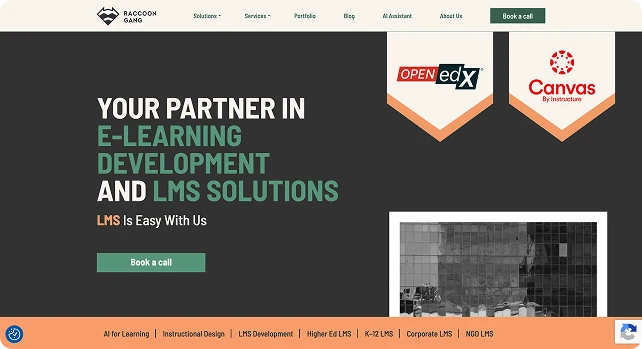
Raccoon Gang is one of the most credentialed Open edX implementation partners globally. If Open edX is your platform and you need a team that can extend, configure, and maintain it properly, they’re a logical first call.
To state plainly the challenge of joining forces with them, the open-source total cost of ownership is almost always higher than the sticker price suggests. Hosting, plugin maintenance, security patches, and the engineering hours required to keep a Moodle or Open edX installation typically run $35–90K+ per year, sometimes more. Compare the full three-year cost, not just the licensing line, before treating open-source as the economical option.
This is the right choice if you’re already in the Open edX world or have specific reasons to be there. But it’s not a cost-cutting path for companies that haven’t already made that commitment.
The rest of the list will cover our third category: SaaS partners.
2 SaaS partners worth knowing
SaaS operates in a different context from everything above: they configure and extend platforms you don’t own, on roadmaps you don’t control. For companies that run on Cornerstone, SAP SuccessFactors, or Workday Learning, having the right partner is critical. These are the two we’d point you toward.
Bluewater Learning
Best for: Large enterprises already on Cornerstone OnDemand or Saba that need expert configuration, optimization, and change management.
Bluewater Learning specializes in making enterprise SaaS LMS deployments actually work, which is more involved than it sounds. Cornerstone is one of the most capable platforms in the enterprise market and one of the most difficult to configure correctly. A poorly structured Cornerstone implementation produces a system that’s technically live but unusable.
Bluewater prevents that outcome. They don’t just set up the platform, but also work with HR, L&D, and IT stakeholders to make sure the rollout lands correctly. For enterprises deploying to 10,000+ employees across multiple business units or geographies, that layer is extremely important.
The caveat is that you remain on the SaaS platform’s roadmap and pricing structure. Bluewater extends what exists, but they don’t give you ownership of the infrastructure.
Educe Group
Best for: Best for: HR-led companies integrating learning into a broader HCM stack (Cornerstone, SAP SuccessFactors, Workday Learning).
Educe Group’s value is in the intersection of learning and HR systems. They understand both sides of the integration. If your LMS is one component in a larger HCM investment, and the primary goal is making learning data flow correctly across Workday or SAP, Educe is the specialist to call.
The only problem is that LMS is one part of a broader HCM practice here. If learning is your core product rather than an HR function, this isn’t the right fit.
Recap: Who to call and when
Let’s sum up:
| Company | Type | Best for |
|---|---|---|
| Academy Smart | Custom build | ✔️ Training providers ✔️ Regulated orgs ✔️ LearnUpon extension |
| Plume Studio | Custom build | ✔️ Fast-growing training businesses ✔️ B2B/B2C/healthcare |
| Riseapps | Custom build | ✔️ Healthcare ✔️ Regulated sector apps |
| Raccoon Gang | Open-source (Open edX) | ✔️ Universities ✔️ Large-scale public programs |
| Bluewater Learning | SaaS | ✔️ Cornerstone enterprise deployments |
| Educe Group | SaaS | ✔️ HCM-integrated learning (SAP/Workday) |
The most common mistake in this process is evaluating partners before settling the underlying question: do you want to own the infrastructure, or rent it?
If per-seat pricing is already eating into margins, a custom build developed by the best LMS developers is the investment that ends the compounding costs. The math typically closes in under two years. After that, the platform is an asset, not a recurring expense.
If you’re earlier in that curve, extending a well-chosen SaaS platform through a specialist implementation partner is a reasonable intermediate step.
Either way, every company on this list is right for a specific situation, so we hope this list was useful for you. And if you are unsure which category applies to your situation, Academy Smart offers a free LMS usability & tech audit. This is an independent assessment of your current setup before you commit to a direction.
Not sure which LMS development provider to choose?
Book a free consultation and we’ll
recommend the right approach.