



How Much Does Custom LMS Development Cost?

Custom LMS development has a reputation for having eye-watering prices.
The numbers you’ll find online ($200K, $500K, sometimes more) come from projects where teams built everything from scratch. And if you go that route, they’re accurate.
An in-house team runs $730K+ a year in salaries alone. A generalist dev agency quotes $200K+ over 12–18 months. Open-source looks free until you’re paying a full-time engineer to keep it running.
Building from scratch isn’t the only option. If your development partner starts from a pre-built LMS foundation, the numbers are less scary: $17K–$120K, to be specific.
Further down the article, we’ll walk you through four key paths of custom LMS development. We’re Academy Smart, an LMS development company that’s been building learning platforms since 2009, so we’ll also share our own pricing and explain what drives it.
TL;DR
• Custom LMS development costs $910K–$985K/year if you go with a small in-house team. Open-source options like Moodle are free to license but costs 0.5–1.0 FTE just to maintain. A generalist agency quotes $150K+ over 12–18 months.
• The number drops when your tech partner starts from a pre-built foundation. Academy Smart’s pricing: $17K for a ready-made LMS, $85K–$120K for a full custom build in ~6 months, $6K for a CPD dashboard. All prices are one-time with no per-seat fees.
• What moves you within the range: standards complexity, number of integrations, and scale requirements.
• Before you compare these numbers to your SaaS invoice, count what’s not on it. By year three, custom is typically cheaper. Cyber Inc., for example, cut costs by 68%.
What does custom LMS development cost?
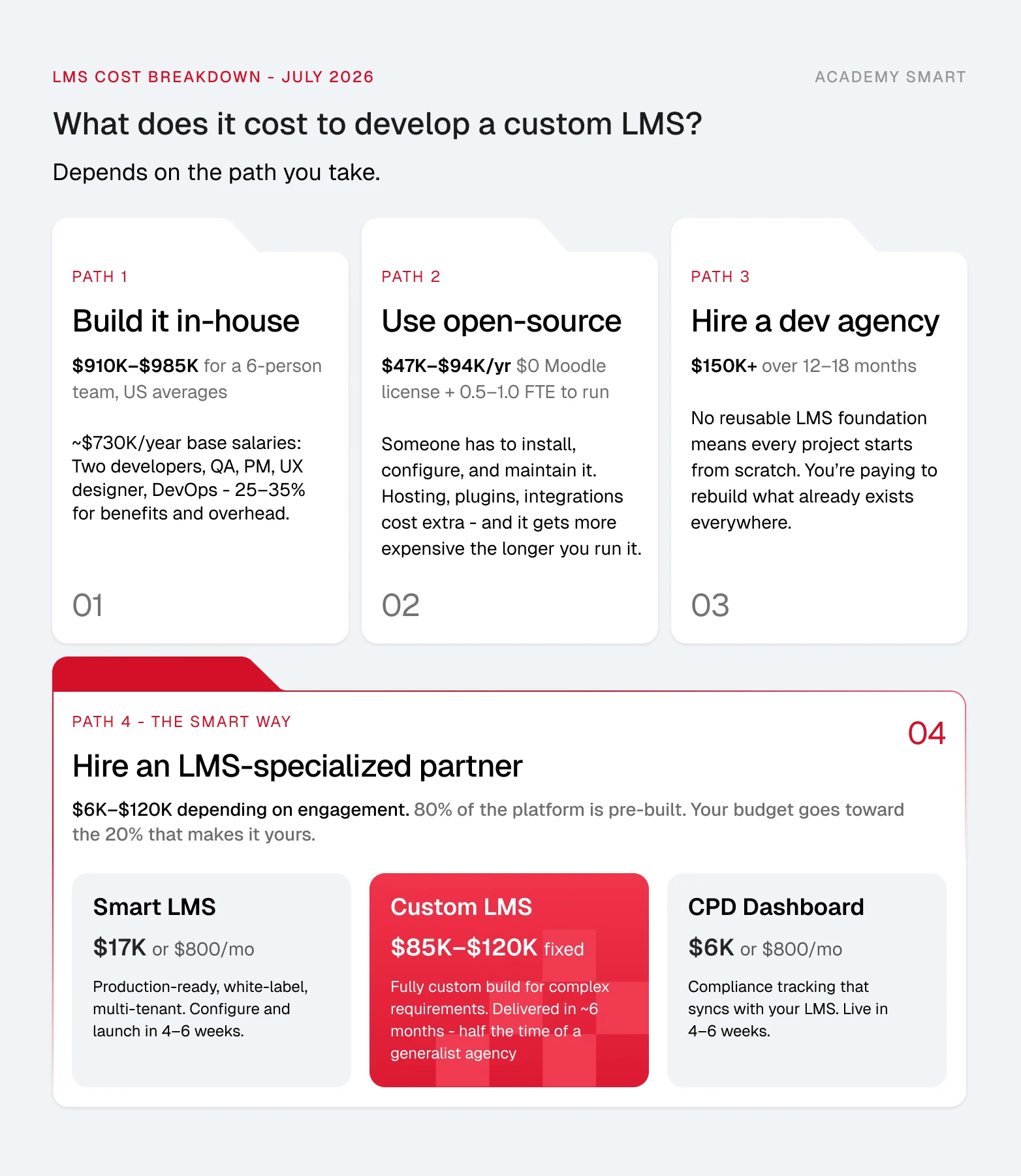
It depends on which path you take. There are four of them:
- Build it in-house. $920K–$990K for a 6-person team, US averages
- Use open-source (Moodle). $0 license + 0.5–1.0 FTE to run ($47K–$94K/year)
- Hire a development agency. $200K+ over 12–18 months
- Hire an LMS-specialized partner. $17K–$120K depending on engagement (prices of Academy Smart)
Path 1. Build it in-house
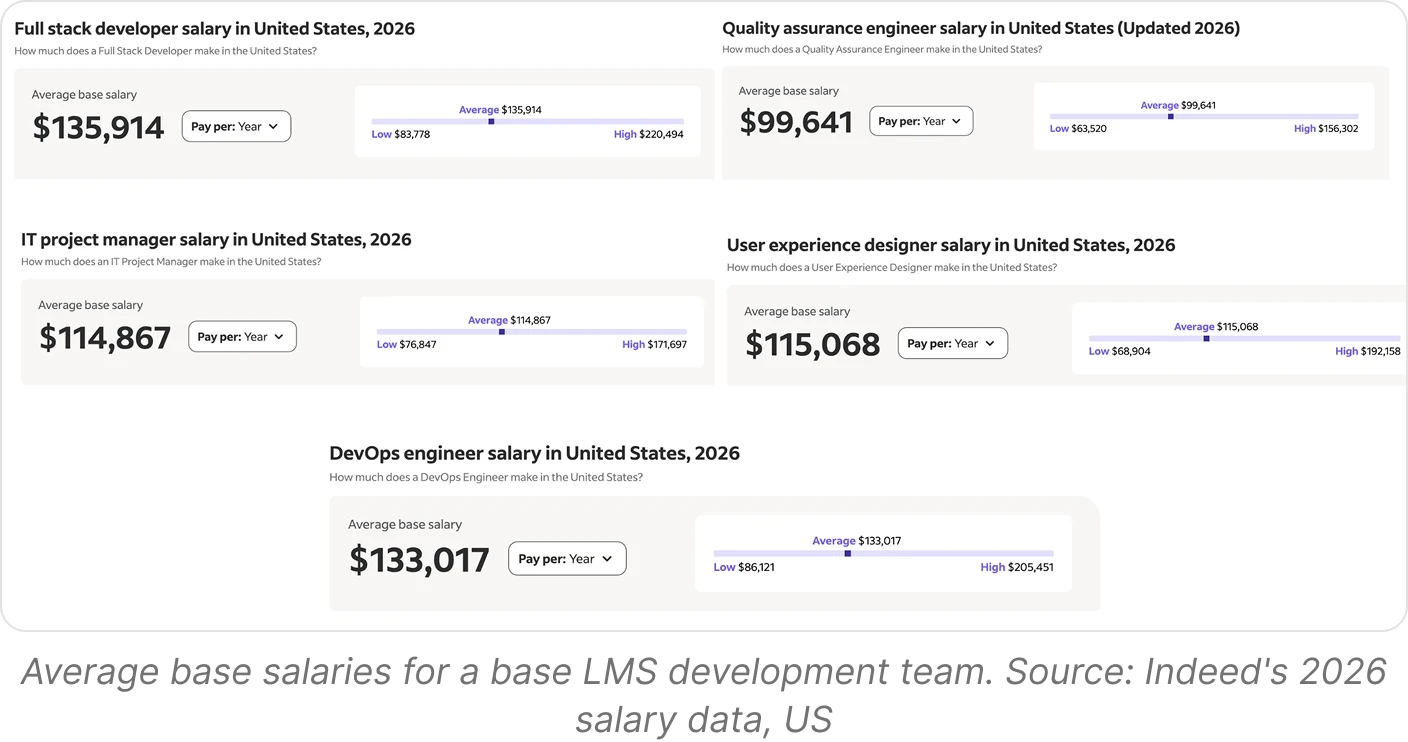
A minimum LMS team in the US requires two full-stack developers, a QA engineer, a project manager, a UX designer, and a DevOps engineer. Based on Indeed’s 2026 salary data, that team costs ~$730,000 per year in base salaries alone. Add benefits, payroll tax, and equipment (typically 25–35% on top), and you’re looking at $910K–$985K before the team is fully assembled and productive. Then factor in 8–12 weeks of recruiting time per role and onboarding.
LMS-specialized developers (people who’ve built SCORM engines, multi-tenant architectures, or CPD rules layers) are its own breed that add to recruitment time. Just search ‘SCORM + developer’ on any job board and count the results.
Path 2. Use open-source
Moodle is the obvious candidate, and the license costs nothing. Someone has to install it, configure it, harden the security, and keep it running, however. That takes a village, and the village needs to be on your payroll.
As Moodle’s own certified partners note, a small-to-midsize self-hosted instance needs 2 to 6 hours a week of routine maintenance (backups, security patching, plugin updates, performance tuning), plus 15 to 30 hours every time Moodle releases a major version. Moodle releases two major versions per year. Over twelve months, that adds up to 0.5 to 1.0 full-time equivalent of staff time, before you’ve customized anything. A systems administrator in the US averages $94,387 per year, per Indeed data.
Customization is where the next cost layer starts. Moodle’s core covers the basics, but connecting it to your HR system, your CRM, or your single sign-on requires plugins or custom development. Premium plugins run $500 to $5,000 each, and custom integrations cost more.
And the longer you run it, the more expensive it gets. We call it the Total Cost of Change:
- Upgrade friction every time Moodle releases a new version and your plugins break,
- Developer onboarding because the person who customized it leaves or moves to another project.
- Rewrite cycles when the quick fix from six months ago turns out to be load-bearing,
- And UX debt that accumulates because Moodle’s interface was designed for universities in the 2000s, which is different from your learners in 2026.
Keeping it running
- 2–6 hrs/week routine maintenance
- 15–30 hrs per major upgrade × 2/year
- Total: 0.5–1.0 FTE of staff time per year
Making it yours
- Premium plugins: $500–$5,000 each
- Custom integrations (HR, CRM, SSO): more
Total Cost of Change
- Every major upgrade risks breaking the plugins you already paid for
- Every developer who leaves takes undocumented knowledge with them
- Moodle’s interface was designed for universities in 2002. Redesigning it is a project of its own
The platform is free, but the village maintaining it isn’t.
Path 3. Hire a software development agency
A generalist agency will typically quote 12–18 months and $200K+ for a custom LMS. Some will have built one before. But unless they own a reusable LMS foundation, every project starts from scratch: user management, course delivery, role-based access, SCORM playback, reporting, multi-tenancy. Every LMS on the market already has those features, so your budget goes toward rebuilding what exists. None of it is your competitive advantage, but it’ll consume most of your timeline and budget.
If you’re considering this path, ask to see LMS-specific case studies with timelines, cost breakdowns, and how much of the build was reusable versus built from zero. If they can’t show you anything, you’re their first.
Path 4. Work with an LMS-specialized partner that doesn’t start from zero
Yes, this is where we talk about Academy Smart. We’ve delivered 500+ LMS projects since 2009, so take our objectivity with a grain of salt. If you want to compare, we put together a list of LMS development companies that do custom builds.
Our delivery model itself is what matters here, and it exists beyond us: if your partner has already built the foundational 80% of an LMS, your project starts at a different price point. Your budget goes toward the 20% that makes the platform yours. CPD workflows, integrations with your HR and CRM systems, custom reporting, AI features, the specific business logic that your SaaS LMS can’t be configured to do, and the like — everything is adjusted to your needs.
Here’s how that changes the cost.
What does it cost to work with an LMS-specialized partner?
While we can’t quote you every LMS-specialized partner’s pricing, we can show you ours, and why the numbers land where they do.
Along our 15+ years of LMS experience, we’ve productized the parts that repeat across every project: user management, course delivery, SCORM, reporting, multi-tenancy. That’s the foundation. What varies is how much gets built on top of it.
We offer three engagement models. Two of them are ready-made products you can deploy in weeks. The third is a fully custom build that still delivers in roughly half the time of a generalist agency.
Smart LMS
$17K or $800/mo
Production-ready, white-label, multi-tenant. Configure and launch in 4–6 weeks.
Custom LMS
$85K–$120K fixed
Fully custom build for complex requirements. Delivered in ~6 months – half the time of a generalist agency
CPD Dashboard
$6K or $800/mo
Compliance tracking that syncs with your LMS. Live in 4–6 weeks.
Note: Every engagement is a one-time license. You own the platform, host it on your infrastructure, and add users without per-seat fees. If Academy Smart disappeared tomorrow, your platform would keep running on your servers with your team.
Starter LMS for training providers who need to launch fast
If you don’t need to reinvent the wheel — just a platform that works, looks like yours, and is live in a month — this is the entry point. Our Starter LMS costs $17,000 as a one-time payment, or $800 per month if paying monthly is easier to approve internally. Either way, you get a production-ready, white-label LMS with multi-tenant architecture, SCORM/xAPI support, learning path builder, role-based access, and bulk onboarding already built in.
Multi-tenant
architecture

SCORM, xAPI & AICC out of the box

Unlimited learners, zero per-seat fees

White-label & fully brandable

We configure it to your setup and brand each tenant with your own logo, colors, and domain. If you need customization beyond configuration, that’s scoped and estimated separately. A typical timeline from scoping call to live platform is 4–6 weeks.
Custom LMS: for organizations that have outgrown their SaaS
The custom LMS is a fixed-price engagement at $85,000–$120,000, paid over the 6–7 months it takes to deliver. This is for organizations with complex requirements. Things like multi-region rollout, thousands of concurrent users, compliance-heavy environments, or custom integrations with HR, CRM, SSO, and payment systems. The first 100 hours of migration from your existing LMS are included.
We ship your LMS in approximately 6 months through our 80/20 LMS Delivery Model. That’s roughly half the timeline of a generalist agency because 80% of the platform is already built before your project starts. The remaining 20% is the part that makes it yours.
pre-built foundation
Use existing solutions for common LMS functions
custom business logic
Focus engineering time on unique business needs
Case in point: Cyber Inc., a security awareness training provider, got their live multi-tenant LMS in 5 months, serving 86 client companies across 27 languages, at 68% less than their previous SaaS costs over three years. Blue EQ launched a learning platform for 38,000+ users with OpenAI integration and 25 individually tracked EQ competencies on the same foundation.
CPD Dashboard: for regulated organizations that need to prove compliance
Not every organization needs a full LMS. Some already have one; they just can’t prove compliance with it. For those cases, Academy Smart offers a standalone CPD Dashboard at $6,000 one-time, or $800 per month.
It’s a ready-made compliance tracking platform that syncs natively with LearnUpon and Docebo, tracks both internal and external training activities, enforces CPD rules by role, department, and region, and produces audit-ready exports.
Syncs natively with LearnUpon and Docebo
Tracks both internal and external training activities
Enforces CPD rules by role, department, and region
Produces audit-ready exports
If your current CPD record lives across spreadsheets, emails, and manual logs, this replaces all of that. One of Ireland’s leading corporate law firms, rolled out the CPD Dashboard for 600+ solicitors in 2 months. Their CPD record had been spread across multiple systems; now it’s in one place, audit-ready.
Three things that increase LMS development cost
You’ve seen the range: $85,000–$120,000 for a custom LMS, or $200K+ at a generalist agency. What determines if your project is less or more costly? Three things: how many standards your platform needs to support, how many systems it needs to connect to, and how many users it needs to handle at once. We call this the LMS Cost Stack.
The LMS cost stack
What determines where your project lands in the $85K–$120K range

Standards complexity
An LMS that plays video and tracks completion is relatively simple to build. The cost changes when standards enter the picture:
- SCORM 1.2 and 2004 compliance
- xAPI for tracking learning across external platforms
- LTI for authoring tool connections
- CPD rules that vary by role, region, and regulatory body
Each one has its own specification and its own edge cases.
In practice, the organizations that come to us are rarely in the “just play video” category. One of the recent cases was a health and safety company that was tracking gas engineer CPD renewals in Excel until the spreadsheet got too big and one wrong formula broke everything. Not a simple LMS case — they needed a CPD rules engine on top of one.

Accent Note Card
If your LMS only needs SCORM playback and basic completion tracking, that’s part of our LMS foundation. If you need a full xAPI implementation for tracking learning across external platforms, expect to be at the upper end of the $85K–$120K range.
Integrations
Every organization we work with has at least one integration that their SaaS vendor won’t build. A construction company asked whether we’d integrate their LMS with Power BI, as their HR dashboard already lived there. A shipping company needed its LMS to sync with proprietary crew management software that no SaaS vendor will ever put on its roadmap.
Every integration adds scope: API mapping, data transformation, error handling, and ongoing maintenance when the connected system updates its own API.

How integrations affect your cost
The more systems your LMS needs to talk to, the higher the cost. Clients who come to Academy Smart with 5+ required integrations are typically at the upper end of the $85K–$120K range.
Clients who need the core platform with one SSO connection are closer to the lower end.
Scale
An LMS serving 200 employees in one office has different architecture requirements from one serving thousands across regions. Multi-tenancy, high-concurrency load handling, and global content delivery each add engineering work.
One shipping company we spoke with operates a global fleet where crew cycle on and off vessels. Training records need to persist even when a seafarer is deactivated for six months between contracts. For them, the platform needed to keep training records intact even when a seafarer is deactivated for months between contracts and handle thousands of such records. Our LMS foundation already supports that. The cost variable is hosting and storage at that volume.

How scale affects your cost
Scale moves your cost in steps, not a straight line — and each step is a one-time build cost, not a permanent per-seat tax.
Two things drive it: peak concurrency and tenant count. Total registered users barely matter.
Concurrent users — what counts is peak simultaneous activity, not headcount. Up to ~500 concurrent, the LMS foundation handles it as delivered. Between ~500–2,500, we add caching, a read replica so reporting stops competing with learners, and CDN delivery for media — tuning, not redesign. Above ~2,500, horizontal scaling and queued background processing become real engineering work, which we scope and price explicitly.
Tenants — multi-tenancy is in the foundation, so your first tenant and your fifth cost the same. Up to ~10 is covered. From ~10–50 the cost driver is operations, not architecture: self-serve provisioning, bulk configuration, cross-tenant reporting. Past ~50, tenant requirements diverge — different SSO providers, data residency, retention rules — and stronger isolation is worth it for the ones that need it.
Your SaaS LMS costs more than your invoice shows
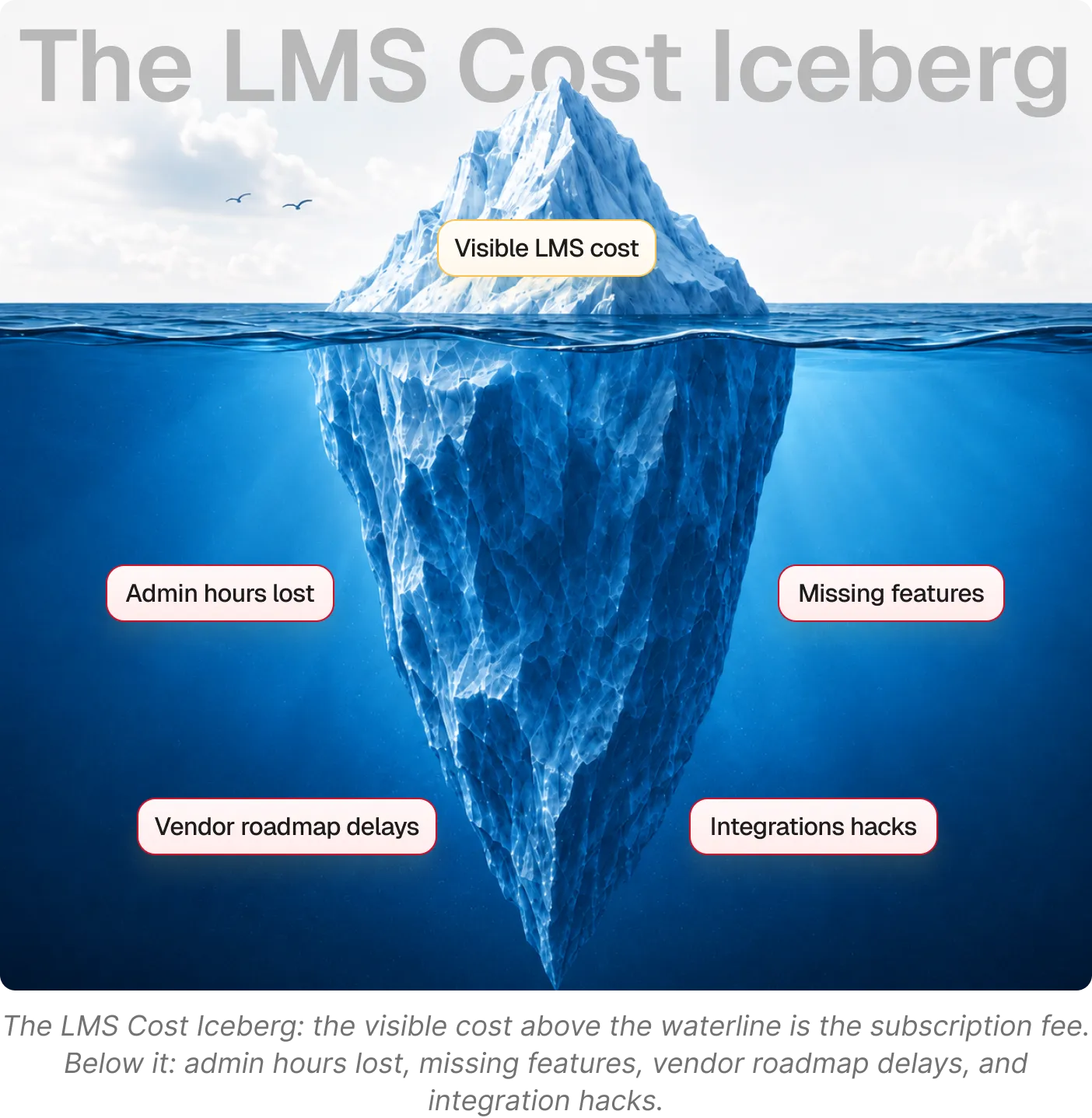
When organizations compare custom LMS pricing to their current SaaS spend, they compare it to the subscription fee. But that’s the visible 20%.
The other 80% doesn’t show up on an invoice:
- Admin hours on manual workarounds because the feature you need doesn’t exist.
- Integration hacks: Zapier chains, CSV exports, copy-paste between systems
- CPD tracking in spreadsheets alongside the LMS because the platform doesn’t handle compliance natively.
- Waiting six months for a feature request that never ships
- Paying 3–10% more per seat at every renewal without getting more functionality.
Even with those hidden costs counted, SaaS is cheaper in year one. There’s no upfront investment, you’re live in weeks, and the monthly fee is predictable. But the math shifts when your subscription renews at a higher price, or your workarounds don’t go away.
A custom LMS, by contrast, has no recurring license fees. After launch, you’re paying for support and hosting only. By year three, the lines cross. Cyber Inc saw this: 68% lower costs than their previous SaaS over three years.

Three signals that you’ve already crossed that threshold:

You pay per seat and your margins shrink as you add users
You need CPD tracking or integrations your vendor won’t build
Your roadmap depends on your vendor’s priorities, not yours
Check out the numbers for your business. Our SaaS vs. Custom LMS calculator lets you plug in your seat count, subscription, and growth rate to see the three-year comparison.